
By Suzanna Winters October 4, 2026
For UCC lien removal after MCA payoff, first prove the MCA is fully satisfied, identify the exact financing statement and current secured party of record, and request a UCC-3 termination. For an ordinary business filing, state Article 9 commonly gives the secured party 20 days after receiving a qualifying signed demand—not automatically 20 days from the payoff date—to act when the statutory conditions are met.
A merchant can finish paying an MCA, receive a zero-balance confirmation, and still find the old UCC-1 in a public filing search. That does not necessarily mean the MCA remains unpaid. It means payment of the underlying obligation and disposition of the public financing statement are separate closeout steps.
The practical goal of UCC lien removal after MCA payoff is therefore not simply to get somebody at the funding company to say, “the account is paid.” You want a documentary trail showing the obligation was satisfied, the correct UCC filing was identified, the party with authority was contacted, the appropriate termination was filed or delivered, and the filing history was checked again afterward.
One jurisdictional point matters from the start: Article 9 is state law. States have enacted versions of the Uniform Commercial Code, and wording, statutory numbering, filing interfaces, forms, and search practices can differ.
This guide uses current Illinois statutory provisions as a clear enacted Article 9 example and current California Secretary of State procedures as a filing-office example. Always verify the statute and filing rules for the jurisdiction governing your own financing statement.
UCC Lien Removal After MCA Payoff: The Fastest Path

A clean UCC lien removal after MCA payoff process is mostly a matter of getting the sequence right. Do not begin with a self-filed UCC-3 simply because a financing statement still appears online.
Use this seven-step workflow:
- Confirm the MCA is completely satisfied: Make sure the final debit actually resulted in a zero balance and that no continuing obligation, renewal balance, settlement term, or future-advance commitment remains.
- Obtain written payoff evidence: Ask for a payoff confirmation, zero-balance letter, satisfaction letter, or similar written record.
- Run the correct Secretary of State search: Find the initial financing statement, filing number, filing date, secured party, assignments, continuations, amendments, and any existing termination.
- Identify the current secured party of record: Do not assume the company that originally funded the transaction still controls the filing.
- Send a documented termination demand: Reference the exact initial financing statement and applicable enacted termination statute.
- Track the statutory response period: For the ordinary commercial framework discussed below, the 20-day period generally follows receipt of the qualifying demand when the statutory conditions are satisfied.
- Verify the result: Save the accepted UCC-3 acknowledgment and run a new search.
The rest of this guide explains each step and the situations that can complicate them.
Step 1: Prove the MCA Is Actually Paid Off
Before asking anyone to terminate a filing, establish that the transaction covered by that filing is truly finished.
Your closeout evidence should include:
- payoff statement;
- ACH, wire, or other final-payment confirmation;
- proof of the last debit;
- zero-balance or satisfaction letter;
- MCA or funding agreement number;
- legal business name;
- debtor name used in the UCC record;
- original financing statement number;
- assignment notices;
- renewal or refinance documents;
- settlement documents, if applicable; and
- emails or letters confirming satisfaction.
For UCC lien removal after MCA payoff, a bank statement showing the last debit is useful but not always enough. It proves money moved. It may not independently prove that every obligation covered by the financing statement has been extinguished.
That distinction comes directly from the termination statute. Illinois §9-513(c), for example, applies the ordinary commercial termination-demand rule when the required conditions exist, including—most relevantly for a normal secured business obligation—no remaining obligation secured by the collateral and no commitment to make another advance, incur an obligation, or otherwise give value.
This matters especially after a refinance, renewal, discounted settlement, restructuring, or payoff funded by another financing company. A “last payment” can be operationally different from full contractual satisfaction.
If the account was renewed, confirm whether the old financing statement was supposed to terminate or whether it continued to cover the replacement obligation. If there was a settlement, confirm the settlement conditions were actually fulfilled.
Do not demand termination of a record until you understand what that record relates to.
Step 2: Run a Secretary of State UCC Search
A secretary of state UCC search is the starting point for identifying exactly what is on file. But first determine the correct filing jurisdiction rather than searching only the state where the store, restaurant, office, or warehouse happens to operate.
The filing jurisdiction and debtor name should be confirmed before relying on the search results. California’s official UCC filing guidance on debtor names, indexing, and the proper place to file illustrates the filing-office issues to check, including the exact legal name of a registered organization and how UCC records are indexed.
Article 9’s debtor-location rules generally place a registered organization organized under state law in its state of organization. Current Illinois §9-307, for example, states that a registered organization organized under the law of a state is located in that state. Other debtor categories follow other rules.
So an LLC organized in Delaware but operating from Florida should not assume Florida is automatically the only place to search. Verify the applicable filing rule first.
California’s official UCC guidance also emphasizes exact debtor identification and makes clear that registered organizations should use the legal organizational name reflected in their governing public record.
A practical secretary of state UCC search should capture more than “something came up under my company.”
| Search Item | What to Record | Why It Matters |
| Debtor legal name | Exact indexed name | Confirms you found the correct debtor |
| Initial financing statement number | Full file/reference number | Connects later amendments to the right UCC-1 |
| Filing date | Official filing date | Separates older and newer financing positions |
| Secured party of record | Current indexed name | Helps determine who may control termination |
| Assignments | Any transfer of secured-party status | Original funder may no longer have authority |
| Continuations | Filing dates and numbers | Shows whether effectiveness was extended |
| Amendments | Relevant party or collateral changes | May alter who or what the filing covers |
| Termination | Whether one is already indexed | May show the financing statement was already terminated |
California currently provides an official online UCC database through its Secretary of State. The portal warns that an online result is not necessarily a complete or certified record, which is why a formal certificate may be appropriate when another lender needs official evidence.
Do not terminate based merely on the name of a familiar funder. If several MCAs, equipment financings, lines of credit, or other secured transactions exist, record each initial financing statement separately.
Step 3: Determine Whether the Filing Is Active, Terminated, Assigned, Continued, or Lapsed
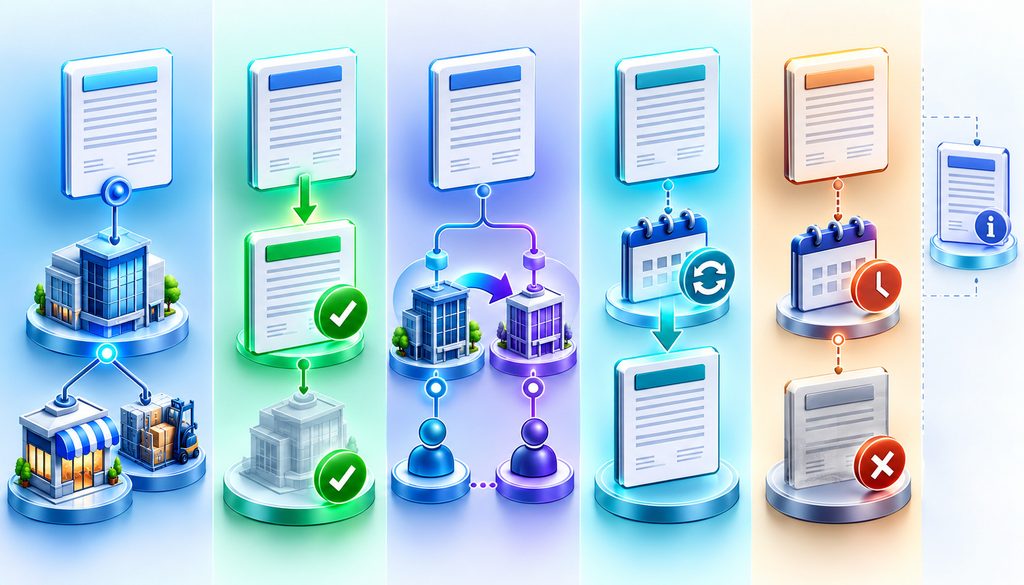
Before trying to remove UCC-1 after payoff, identify what the filing history actually says.
An initial financing statement can have later amendments connected to it. Those amendments may show an assignment, continuation, collateral change, secured-party change, or termination.
When reviewing the filing history, separate the original financing statement from later assignments, continuations, amendments, and termination records. Understanding how UCC-1 filings, UCC-3 amendments, assignments, continuations, and lien searches fit together makes it easier to match each public record to the MCA that has actually been paid off.
| Record Status | What It Generally Means | What to Do |
| No termination located | Financing statement may remain effective | Match it to payoff documents |
| Termination filed | Financing statement ceases to be effective to the extent authorized by law | Save the acknowledgment |
| Continuation filed | Filing effectiveness has been extended | Confirm which obligation remains |
| Assignment filed | Another secured party may now control amendment authority | Contact the current party |
| Lapsed | Filing effectiveness has expired under applicable Article 9 rules | Verify history rather than assuming payoff |
| Information statement/UCC-5 | A party has stated that a record is inaccurate or wrongful | Do not treat it as a termination |
Lapse is not the same as termination
Illinois §9-515 provides the familiar general rule that a financing statement is effective for five years unless an exception applies. A timely continuation can extend that effectiveness for another five-year period, and later continuations can extend it again.
That does not mean every financing statement simply “disappears after five years.” Nor does lapse prove that an MCA was paid.
Lapse concerns filing effectiveness under Article 9. A UCC-3 termination after payoff gives a future underwriter a more direct documentary connection between the satisfied transaction and the financing statement.
A UCC-5 does not terminate the financing statement
California Commercial Code §9518 and Illinois §9-518 both make this point clearly: An information statement can be used to state that a filing is inaccurate or was wrongfully filed, but it is not a substitute for a termination. The current Illinois UCC §9-518 information-statement rule expressly provides that filing an information statement does not affect the effectiveness of the initial financing statement or another filed record.
California’s Secretary of State filing guidance says the same thing operationally: the information statement is indexed, but the other filing information is not changed or removed merely because the UCC-5 was filed.
That is why filing a UCC-5 is not a substitute for a properly authorized termination.
Step 4: UCC-3 Termination Statement Merchant Cash Advance Closeout—What It Actually Does
A UCC-3 termination statement merchant cash advance closeout uses the financing-statement amendment process to terminate the effectiveness of the identified initial financing statement when the filing is authorized.
A UCC-3 is the financing-statement amendment used for several different actions, not just termination. The official California UCC Financing Statement Amendment instructions identify Form UCC3 for terminations, continuations, assignments, and other amendments, which is why the filing must identify the correct initial financing statement and the correct amendment action.
The state’s current Forms and Fees page says California accepts the current National Financing Statement Amendment form and identifies UCC3 specifically for terminations and other amendments.
A termination must identify the financing statement it relates to. It is not a generic letter saying the account is paid.
Illinois §9-513(d) and California Commercial Code §9513(d) state that, subject to the filing-authorization rules, filing the termination causes the financing statement to which it relates to cease being effective.
That is the legal mechanism merchants usually mean when they say they want to remove UCC-1 after payoff.
But “remove” can be misleading. A termination does not necessarily erase the UCC-1 from the filing office’s historical database.
California, for example, expressly states that termination statements are indexed to the associated filing and that termination does not normally change the record’s status in the index in the way a consumer might expect. Terminated records may remain part of search history.
So the practical objective of UCC lien removal after MCA payoff is termination of the financing statement’s legal effectiveness where appropriate—not destruction of the historical public filing.
UCC-1 vs. UCC-3 vs. UCC-5
| Filing | Primary Purpose | Typical Post-MCA Role | Does It Terminate the Financing Statement? |
| UCC-1 | Initial financing statement | Original public notice filing | No |
| UCC-3 | Amendment, assignment, continuation, termination | Used to terminate the identified UCC-1 when authorized | Yes, when properly filed and authorized as a termination |
| UCC-5 / Information Statement | States that a record is inaccurate or wrongfully filed | May document a dispute | No |
A UCC-3 termination statement merchant cash advance procedure should therefore never be confused with filing an information statement merely because the secured party is slow to respond.
Step 5: Understand the 20-Day UCC §9-513 Rule
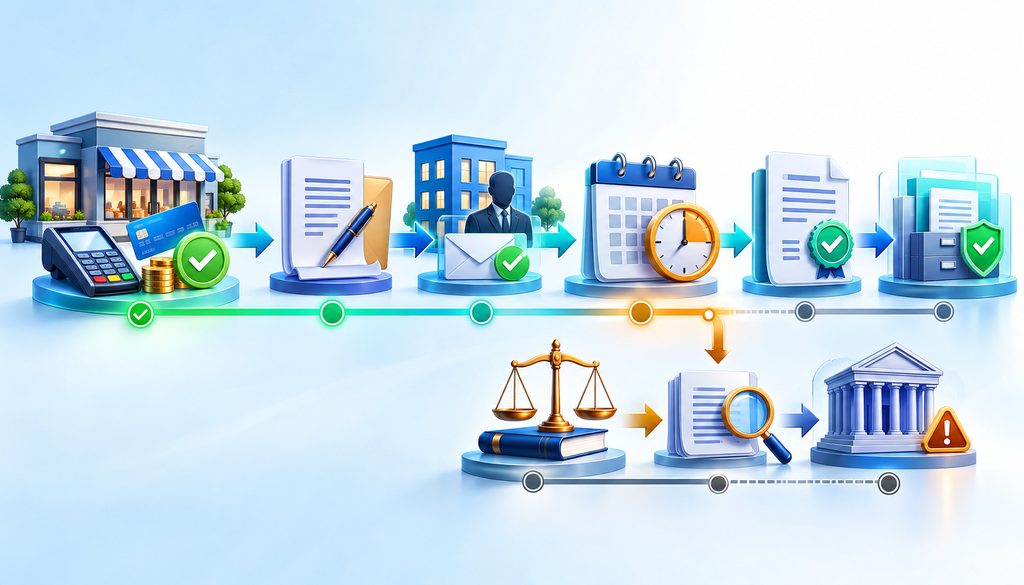
The most common error in discussions of UCC lien removal after MCA payoff is the statement that “the lender has 20 days from payoff to remove the lien.”
That is not the rule for the ordinary business-filing scenario reflected in current Illinois and California law.
Consumer-goods filings have a different rule
For consumer goods, Illinois §9-513(a) and (b) impose a different termination framework. Among other things, the statute provides a one-month rule after the secured obligation and advance commitment have ended, or—if earlier—20 days after receipt of a signed debtor demand.
That consumer rule should not casually be copied into an MCA article.
Ordinary commercial or business collateral
For an ordinary commercial filing, do not automatically count 20 days from the MCA payoff date. Under the current California Commercial Code §9513 termination rule, a secured party generally has 20 days after receiving the debtor’s signed demand to cause the secured party of record to send or file a termination statement when one of the statutory conditions is satisfied.
For an ordinary secured business transaction, the key condition is generally that there is no obligation secured by the collateral covered by the financing statement and no remaining commitment to advance or otherwise give value.
California Commercial Code §9513(c) currently uses essentially the same commercial structure and also uses “signed demand.”
Therefore:
The 20-day period should generally be tracked from receipt of the qualifying demand—not automatically from the MCA payoff date—when the applicable commercial-filing statute uses this framework and its other conditions have been satisfied.
Older or model-UCC discussions may use “authenticated demand.” Current enacted wording can differ by state. Use the terminology in the law that governs the actual financing statement.
Step 6: Send a Formal UCC Termination Demand
For UCC lien removal after MCA payoff, a documented demand is better than a chain of phone calls because it creates evidence of exactly what you requested and when it was received.
Your demand should generally identify:
- full legal business name;
- DBA, if helpful;
- funding agreement number;
- initial UCC filing number;
- filing jurisdiction;
- original filing date;
- current secured party shown in the record;
- payoff date;
- payoff or zero-balance evidence;
- request for a termination statement;
- applicable state statutory citation;
- date of the demand;
- requested acknowledgment; and
- business contact information.
Do not assume certified mail is universally required. What matters is satisfying the applicable statute while preserving reliable evidence of the record sent and the date of receipt.
Sample UCC Termination Demand Letter
The following UCC termination demand letter is designed as an operational starting point. Replace the statutory reference with the actual enacted citation for the filing jurisdiction before sending it.
[Date]
[Secured Party]
Re: [Business Legal Name]
Agreement No.: [Agreement Number]
Initial Financing Statement No.: [Initial UCC Filing Number]
Filing Jurisdiction: [Filing State]
To Whom It May Concern:
[Business Legal Name] has completed the payment and satisfaction requirements applicable to the merchant cash advance or commercial funding agreement identified above. The final payment was made on [Payoff Date].
Enclosed or attached are documents supporting satisfaction of the obligation, including [payoff statement, zero-balance confirmation, payment confirmation, or other applicable evidence].
A review of the Uniform Commercial Code records for [Filing State] shows initial financing statement [Initial UCC Filing Number], filed on [Filing Date], in connection with [Business Legal Name]. The filing currently identifies [Secured Party] as the secured party of record, subject to any assignment or amendment shown in the filing history.
Please file, or send to us as permitted by applicable law, the appropriate termination statement relating to this financing statement and provide the filing acknowledgment or other official confirmation after completion.
This UCC termination demand letter is intended as the debtor’s written demand under the applicable enacted equivalent of UCC §9-513. For jurisdictions whose commercial termination rule provides a 20-day period after receipt of a qualifying signed demand when the statutory conditions are satisfied, please respond within that applicable period.
If you believe that an obligation, commitment to make further advances, assignment, or other interest covered by the financing statement remains outstanding, please identify the basis for that position in writing.
Please send confirmation to:
[Business Legal Name]
[Authorized Representative]
[Address]
[Email]
[Telephone]
Sincerely,
[Authorized Representative]
Keep a complete copy of the UCC termination demand letter, all attachments, and delivery evidence. Do not rely only on a sent-email timestamp if you cannot establish receipt.
Step 7: What If the Funder Won’t Terminate UCC Filing Records?
When a funder won’t terminate UCC filing records after a documented demand, Article 9 may eventually provide a debtor-authorized termination route. It is a controlled statutory remedy, not permission to file a UCC-3 immediately after payoff.
During the first 20 days—or the applicable state period
Preserve:
- the demand;
- proof of its contents;
- attachments;
- delivery confirmation;
- evidence of receipt;
- follow-up emails;
- account correspondence; and
- the UCC search report.
Check whether the financing statement has been assigned. The original MCA provider may not be the current secured party of record.
Also rerun the filing search before assuming no action occurred. A termination may have been submitted without the secured party sending you a separate confirmation.
After the statutory period expires
If the secured party does not satisfy its termination obligation after the applicable statutory conditions and response period are met, state law may provide a debtor-authorized filing route.
The current Illinois UCC §§9-509 and 9-510 filing-authority provisions state that a debtor may authorize a termination amendment when the secured party of record failed to file or send the termination required by §9-513 and the termination statement indicates that the debtor authorized the filing.
This is why UCC lien removal after MCA payoff can sometimes proceed without a cooperative funder—but only after the statutory predicates are actually satisfied.
Section 9-510 adds an equally important limitation: a filed record is effective only to the extent that it was filed by a person entitled to file it under §9-509. In other words, acceptance by the Secretary of State filing system does not itself prove that the person submitting the termination had legal authority.
Before considering debtor self-filing, confirm:
- The secured obligation has actually been extinguished.
- No covered commitment to make additional advances remains.
- The correct initial financing statement has been identified.
- The current secured party of record has been identified.
- A legally sufficient signed/authenticated demand was sent under the applicable state law.
- You can establish when the secured party received it.
- The applicable statutory waiting period has fully expired.
- The enacted state equivalent of §9-509 authorizes debtor filing in these circumstances.
- The current filing-office instructions have been reviewed.
- The termination will identify the correct filing.
- There is no unresolved payoff dispute, assignment problem, litigation, settlement condition, or multi-party issue.
If any of those points is uncertain, have commercial/UCC counsel review the situation before submitting a debtor-authorized termination.
What If the MCA Funder Is Out of Business?
An MCA provider going out of business does not automatically give the merchant authority to file a termination.
Work through the record methodically:
- Search the financing-statement history for assignments.
- Identify the current secured party of record.
- Search the relevant business registry for the funder’s current legal status.
- Review all payoff and servicing correspondence.
- Determine whether there is a successor, assignee, servicer, receiver, trustee, or other party administering the account.
- Send the applicable demand to the best-supported current address or authorized contact.
- Preserve delivery evidence.
- Review the filing state’s enacted versions of §§9-509 and 9-513.
- Obtain legal review before debtor self-filing if authority is uncertain.
The original funder’s dissolution can actually make UCC lien removal after MCA payoff more documentation-intensive because the merchant must determine whether control of the filing moved elsewhere.
Who Is Legally Allowed to File a UCC-3 Termination?
There is an important distinction between the person physically submitting a UCC-3 and the person legally authorizing it.
A filing company, lawyer, employee, or electronic filing service might physically transmit the document. The legal question is whether the filing was authorized under the applicable Article 9 provision.
| Situation | Who May Authorize the Termination? | Merchant Action |
| Cooperative funder | Secured party of record or authorized party | Request filing and confirmation |
| Financing statement assigned | Current secured party of record | Contact the assignee |
| Statutory demand ignored | Debtor may have authority when §9-509/§9-513 conditions are met | Verify state law carefully |
| Payoff disputed | Authority may be contested | Obtain legal review |
| Funder dissolved | Depends on successor, assignment, and statutory facts | Investigate before filing |
| Multiple secured parties of record | Rights may differ among parties | Review each party’s status |
Illinois §9-509 expressly governs who may file amendments, while §9-510 limits the effectiveness of filed records to the extent they were filed by an authorized person.
That is why a merchant trying to remove UCC-1 after payoff should never treat the Secretary of State portal like a simple customer-service correction form.
Termination Does Not Mean the Historical UCC-1 Disappears
A properly authorized termination affects the financing statement’s effectiveness; it does not necessarily erase the original UCC-1 from the public filing history. California’s official UCC indexing and record-status guidance explains that a termination statement is indexed to the associated filing and may continue to appear in a debtor search.
California’s official filing guidance explains that termination statements are indexed to the associated financing statement and may remain included in debtor search results.
So review the entire filing history. You may see:
Initial UCC-1 → assignment or continuation → UCC-3 termination
That history can be exactly what a future lender needs to see.
The presence of the original UCC-1 in historical results therefore does not, by itself, establish an active debt or show that the termination failed.
Why a Paid MCA Filing Can Still Create New-Lender Questions
A UCC filing is part of a public notice system. A new lender may search a business and find an older initial financing statement, a continuation, one or more assignments, and no obvious termination.
That does not automatically prove the MCA is still outstanding. Filing offices do not adjudicate the underlying debt each time a search is performed.
California’s Secretary of State tells filers that they are responsible for legal sufficiency, completeness, and accuracy, and that the office indexes information as presented.
For underwriting purposes, a new lender may reasonably ask the applicant to provide:
- payoff confirmation;
- zero-balance letter;
- UCC-3 acknowledgment;
- updated UCC search;
- assignment history;
- subordination, if applicable; or
- another release document required by the underlying financing structure.
The problem is therefore often documentary, not proof that a live MCA exists.
Hypothetical example
A contractor pays off an MCA in June. In August, the contractor applies for a bank line of credit.
The bank’s search shows an older financing statement with no visible termination. The contractor obtains the MCA payoff letter, identifies the correct filing number and current secured party, sends the statutory demand, receives the filed UCC-3 acknowledgment, obtains an updated search, and gives the entire package to the bank.
The example does not assume that every bank follows the same underwriting policy. It illustrates why a clean paper trail can resolve questions more efficiently.
Common Mistakes That Delay UCC Lien Removal After MCA Payoff
Many delays in UCC lien removal after MCA payoff are caused by procedural errors rather than complicated legal disputes.
1. Assuming payoff automatically updates the public filing
The bank account balance and Secretary of State index are separate systems.
2. Searching only under a DBA
A UCC filing may be indexed under the debtor’s exact legal name. Search using the correct registered name and applicable filing rules.
3. Contacting the original funder after an assignment
If another party became the secured party of record, the original funder may no longer be the right party to authorize termination.
4. Sending a vague request
“Please remove my lien” is weaker operationally than identifying the exact financing statement number, filing jurisdiction, agreement, payoff date, and statutory basis.
5. Starting the 20-day count on the payoff date
For the commercial §9-513 structure verified above, the key clock is tied to receipt of the qualifying signed demand when the statutory conditions are satisfied.
6. Self-filing immediately
A debtor-filed termination requires statutory authority. Section 9-509 is not an automatic self-help shortcut.
7. Filing a UCC-5 instead
An information statement does not terminate the financing statement.
8. Terminating the wrong financing statement
This is especially dangerous when several MCA, equipment, or bank filings exist.
9. Losing the acceptance acknowledgment
Keep the official filing confirmation permanently.
10. Expecting the UCC-1 to vanish from history
A termination can be effective while the original filing remains visible as part of the historical index.
UCC Termination Demand Timeline
Use this workflow rather than relying on memory:
| Stage | Action | Evidence to Save |
| Payoff | Confirm zero balance and satisfaction | Payoff statement and payment proof |
| Initial search | Perform Secretary of State UCC search | Search report |
| Filing review | Identify UCC-1, assignments, continuations and secured party | Complete filing history |
| Demand | Send signed/authenticated demand | Copy plus delivery evidence |
| Statutory period | Track the correct deadline | Calendar and receipt record |
| Cooperative termination | Obtain UCC-3 acknowledgment | Accepted filing copy |
| No response | Verify statutory debtor authority | Statutes, demand and receipt evidence |
| Final verification | Run a new search | Updated search or search certificate |
| Closeout | Assemble permanent file | All records together |
Do not invent a universal Secretary of State processing time. Filing systems, review methods, search updates, fees, and certification options differ by jurisdiction.
Post-Payoff Closeout Checklist
Use this checklist for every UCC lien removal after MCA payoff project:
- Final payment confirmed
- Zero-balance or satisfaction letter received
- Legal debtor name confirmed
- Filing jurisdiction confirmed
- Secretary of State UCC search completed
- Exact initial financing statement number recorded
- Filing date recorded
- Current secured party of record identified
- Assignment history reviewed
- Continuations reviewed
- Existing termination checked
- Termination demand prepared
- Applicable statute verified
- Demand delivered
- Proof of receipt saved
- Applicable response period tracked
- UCC-3 termination confirmed
- Filing acknowledgment saved
- Updated search obtained
- Personal-guarantee release checked separately where relevant
- Processor, lockbox, or account-control instructions checked separately
- Permanent closeout package stored
Paying the MCA does not automatically establish that every separate guarantee, processor instruction, lockbox arrangement, deposit-account control document, or other contract has been formally released. Review the agreement and payoff package instead of assuming the UCC-3 handles every related document.
What Your Final MCA Closeout File Should Contain
A complete post-payoff file should contain:
- original funding agreement or identifying contract copy;
- payoff statement;
- proof of final payment;
- zero-balance or satisfaction letter;
- original financing-statement search;
- assignment and continuation history;
- UCC termination demand;
- proof of demand delivery and receipt;
- accepted UCC-3 acknowledgment;
- updated UCC search;
- separate guarantee release, if one exists;
- processor or lockbox release, where relevant; and
- relevant correspondence with successors, servicers, or assignees.
This package is far more useful to a future underwriter than a screenshot of a bank debit plus a verbal statement that the advance was paid.
Frequently Asked Questions
How long does a funder have to terminate a UCC filing after an MCA is paid?
For an ordinary commercial filing, do not automatically count 20 days from payoff. Current Illinois §9-513(c) and California Commercial Code §9513(c) provide a 20-day period after the secured party receives a qualifying signed demand when the relevant statutory conditions are satisfied.
Can I file a UCC-3 termination myself?
Possibly, but only when state law authorizes it. Under Illinois §9-509(d)(2), for example, debtor authorization may arise after the secured party of record fails to file or send the termination required by §9-513, provided the statutory requirements are met and the termination indicates debtor authorization.
Can I remove UCC-1 after payoff myself?
Do not treat remove UCC-1 after payoff as a simple administrative option. First verify payoff, proper demand, receipt, expiration of the applicable statutory period, secured-party identity, state law, and filing-office instructions. If any part is disputed, get legal review.
Does a UCC-3 delete the original UCC-1 from public records?
Not necessarily. A properly authorized termination ends the financing statement’s effectiveness as provided by law, but historical records may remain searchable. California expressly indexes termination statements with their associated filings.
What if the funder won’t terminate UCC filing records?
If a funder won’t terminate UCC filing records, preserve the demand and receipt evidence, rerun the search, check for assignments, wait through the applicable statutory period, and then determine whether the debtor has filing authority under the enacted state equivalent of §9-509. Do not self-file merely because the funder is slow.
What if the MCA company went out of business?
Identify assignments, successors, servicers, receivers, trustees, or other parties reflected in the transaction and filing history. Dissolution alone does not automatically create debtor authority to terminate.
What if my search shows several UCC filings?
Investigate every initial financing statement separately. Do not assume one payoff satisfies several filings or that several filings all belong to the same transaction.
Is a UCC-5 information statement the same as a termination?
No. California §9518(e) and Illinois §9-518(e) expressly state that an information statement does not affect the effectiveness of the initial financing statement or other filed record.
Does a UCC filing disappear after five years?
The general Article 9 rule is five years for an ordinary financing statement, subject to exceptions. A timely continuation can extend the effectiveness for another five years. Lapse should not be confused with documented payoff and termination.
Finish UCC Lien Removal After MCA Payoff With Proof, Not Assumptions
Successful UCC lien removal after MCA payoff should end with a file that another lender can understand without reconstructing the transaction from scratch.
The operational sequence is straightforward:
Payoff evidence → correct filing jurisdiction → Secretary of State search → initial UCC-1 identified → current secured party of record identified → signed/authenticated demand → applicable statutory response period → properly authorized UCC-3 termination → updated search → permanent closeout file.
The objective is not to make every historical reference to the UCC-1 disappear. It is to establish both sides of the closeout: the underlying MCA obligation has been satisfied and the associated financing statement has been dealt with correctly under applicable Article 9 law.
That distinction is what makes UCC lien removal after MCA payoff useful in real underwriting. A future lender does not have to rely on a verbal “paid” statement. The business can provide the payoff record, demand history, UCC-3 acknowledgment, and updated search as one coherent package.
Legal and filing procedures verified against current primary government and enacted UCC sources on October 4, 2026. State-specific statutes, filing forms, filing fees, and Secretary of State procedures should be rechecked before any filing is submitted.