
By Suzanna Winters October 4, 2026
A missed merchant cash advance payment can lead to funder contact, a permitted ACH retry, a contractually authorized rejected-payment charge, reconciliation, or default remedies—but the result depends on the signed agreement. One returned debit does not have the same consequence under every MCA. Review the contract and contact the funder before additional withdrawals fail.
If your missed merchant cash advance payment has already occurred, the priority is not guessing how many “chances” you have left. Determine why the ACH was returned, identify what your contract says about that return, and communicate before another scheduled debit reaches the account.
What to do in the next 24 hours:
- Confirm the bank’s ACH return reason.
- Review the ACH, reconciliation, default, notice, and guaranty provisions.
- Contact the funder before the next scheduled withdrawal.
- Gather current bank, processor, POS, and revenue records.
- Get any reconciliation, payment reduction, pause, modification, or forbearance in writing.
Before deciding how to respond to a revenue decline, identify whether the agreement uses a percentage-based holdback or a fixed bank withdrawal. The difference between daily holdback and fixed ACH repayment matters because a fixed ACH debit can continue at the same scheduled amount even when the business’s sales have fallen.
What Happens After a Missed Merchant Cash Advance Payment?

A scheduled debit normally reaches the designated business bank account through the ACH Network. If the bank does not honor it, the debit is returned with a reason code. An MCA ACH debit returned for insufficient funds is therefore first a payment-processing event; it is not automatically proof that every contractual Event of Default has occurred.
The next step depends on the agreement. The funder may contact the merchant, assess a fee expressly authorized by the contract, conduct an account review, make a permitted reinitiation of the returned entry, or continue with separately scheduled recurring debits.
The practical flow is:
Scheduled ACH → bank return → return reason identified → contract review → contact/retry/reconciliation → cure or modification → possible default escalation
A bounced ACH merchant cash advance debit caused by insufficient funds is also different from intentionally stopping collection, closing the designated account, changing accounts contrary to the agreement, or directing revenue somewhere else.
A June 30, 2026 SEC-filed agreement between Avanza Capital Holdings LLC and NextNRG Inc., for example, separately identifies intentional prevention of collection and certain stopped or blocked ACH activity among potential default events. That language describes this particular contract—not every MCA.
The operational lesson after a merchant cash advance missed payment is simple: identify the return reason before treating it as fraud, diversion, or contractual default.
Bounced ACH Does Not Always Equal an Immediate MCA Default
A returned debit tells you what happened to a payment. A contractual Event of Default tells you whether an event satisfies the merchant cash advance default clause that activates particular remedies.
Those are related questions, but they are not interchangeable.
| Issue | Returned Debit | Contractual Event of Default |
| What happened? | Bank returned an ACH entry | A defined contractual default event occurred |
| Automatic under every MCA? | No | No |
| Can it potentially be cured? | Often possible, depending on agreement | Depends on contract and circumstances |
| Possible fee | Rejected-payment/NSF fee if authorized | Default, collection, legal, or other authorized charges |
| Acceleration risk | Not necessarily | Possible if the agreement authorizes it |
| Guaranty implications | Not automatically | Depends on guaranty trigger |
| UCC/collection remedies | Not established merely by the return | May become relevant if valid contractual and statutory conditions are satisfied |
| Immediate response | Find cause and communicate | Review notice, cure, guaranty, collateral, and remedies |
Contract examples filed with the SEC show why the distinction matters. Clauses may address intentionally interfering with ACH collection, changing the designated bank account, making material misrepresentations, taking prohibited additional financing, withholding required financial information, or preventing access to purchased receivables.
Those clauses are not standardized.
Check the specific MCA agreement.
If you are searching for MCA default what happens, start with four sections of the signed documents: “Events of Default,” “Protections Against Default” or “Remedies,” the ACH authorization, and any personal guaranty.
How Many Bounced MCA Payments Trigger Default?
There is no universal industry rule saying a merchant gets two, three, or any other fixed number of bounced payments before default.
Actual contracts demonstrate why a universal number would be misleading. In a February 19, 2026 MCA agreement filed with the SEC, four or more rejected ACH attempts are listed as one Event of Default, while the same agreement separately addresses interference with ACH collection, insufficient funds, reconciliation, and stacking. Those provisions apply to that agreement; they do not create an industry-wide four-bounce rule.
That conclusion is strongly supported by comparing actual 2026 contracts.
A February 19, 2026 Sale of Future Receipts Agreement between Advance Service Group LLC and Mobilewalla Inc. identifies four or more rejected ACH transactions as one of its Events of Default. The same agreement also separately identifies interference with ACH collection and stacking.
By contrast, a February 11, 2026 Pristine Capital Partners LLC agreement with FullPAC Inc. uses materially different default language. It states that an Event of Default may arise from intentionally false or misleading representations or intentionally preventing the funder from collecting the purchased receivables; it does not establish the Mobilewalla agreement’s four-return threshold as an industry rule.
This is the most important answer for a merchant dealing with a missed merchant cash advance payment: do not rely on a broker, collections representative, online forum, or another merchant’s contract to tell you how many failures your agreement permits.
Read your own merchant cash advance default clause.
Can the Funder Retry a Bounced ACH?
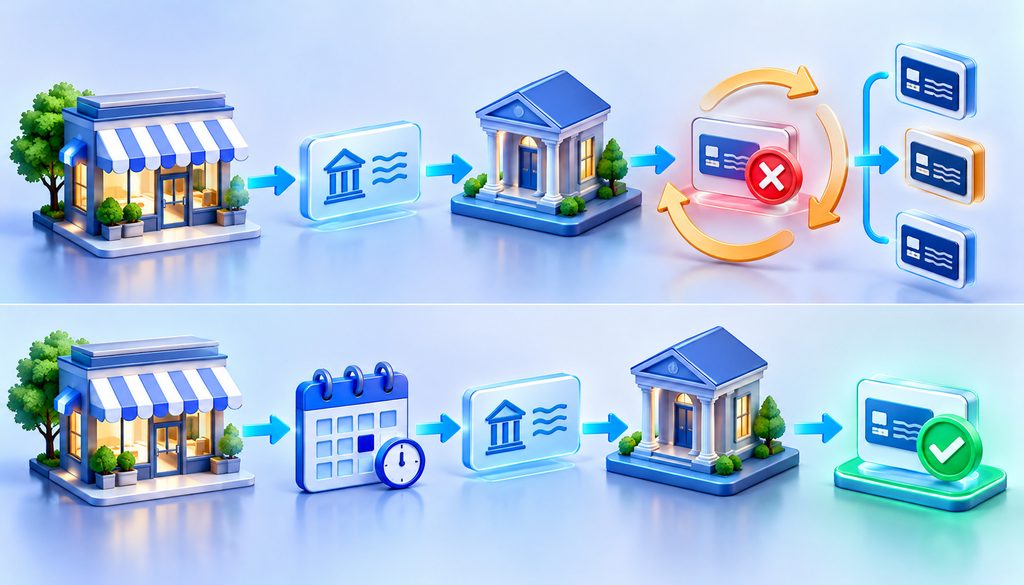
Possibly—but the answer requires separating three different issues:
- The contractual obligation to deliver purchased receivables or make an estimated remittance.
- The merchant’s ACH authorization.
- Nacha’s rules governing reinitiation of returned ACH entries.
Nacha’s public reinitiation guidance says that a debit returned for R01 insufficient funds or R09 uncollected funds may be reinitiated a maximum of two times. It also recognizes limited reinitiation circumstances for certain other returns, including an R08 stop-payment return when separately authorized.
Nacha’s current public rules material further explains that reinitiated entries must use the “RETRY PYMT” Company Entry Description and that an unauthorized debit cannot simply be resubmitted as a valid reinitiation.
A subsequent recurring debit is not treated as a reinitiation merely because an earlier debit in the series was returned, provided that later debit is independently scheduled and not contingent on the earlier return.
ACH reinitiation is not unlimited. Under Nacha’s official rules guidance on reinitiated entries, reinitiation is limited to two times, while separate Nacha guidance explains that a later independently scheduled recurring debit is not automatically treated as a reinitiation of an earlier returned entry.
Operational example
Suppose Monday’s debit produces an MCA ACH debit returned as R01 for insufficient funds.
Whether that exact Monday entry can be submitted again, and how many permissible reinitiations remain, is an ACH-network question. Whether an independently scheduled Wednesday or next-week debit is also due is a separate contractual and authorization question.
A funder cannot turn a contractual collection right into unlimited ACH reinitiations that disregard Nacha’s reinitiation rules. At the same time, an ACH rule limiting a particular reinitiation does not automatically extinguish the underlying contractual obligation.
That distinction is frequently missed in discussions about a bounced ACH merchant cash advance.
What Fees Can Follow a Bounced MCA Debit?
Possible contractual charges include:
- rejected ACH or NSF charges;
- bank-change or blocked-account charges;
- default charges;
- third-party collection costs;
- arbitration or court costs;
- attorneys’ fees where contractually and legally recoverable.
Do not assume an “average MCA NSF fee.” Actual filed agreements vary too much for that statement to be reliable.
For example, the February 2026 Pristine/FullPAC agreement lists a $50 NSF/rejected ACH fee under specified circumstances and a separately stated default fee.
The June 2026 Avanza/NextNRG agreement instead lists an NSF/rejected ACH range of 50–100 and separate blocked-account/default amounts.
The February 2026 Advance Service Group/Mobilewalla agreement has another structure entirely, including a $2,500 rejected-ACH amount if the rejection is not cured under that agreement and a percentage-based default fee.
Those examples show why searches for MCA default fees acceleration cannot be answered with one universal price list.
Check the specific MCA agreement. Contract wording, governing law, the circumstances of the return, and enforceability all matter.
What MCA Acceleration Means in Dollars
Acceleration means that a contract may permit an amount that otherwise would have been remitted over time to become immediately due following a qualifying Event of Default.
Consider this fictional example:
- Remaining purchased amount: $72,000
- Normal estimated weekly remittance: $4,000
- A qualifying default occurs
- The agreement permits the remaining contractual amount to become immediately due
Instead of continuing estimated $4,000 weekly payments, the merchant may face an immediate demand calculated under the agreement.
The numbers above are illustrative only.
Do not calculate acceleration simply by multiplying future scheduled withdrawals. Reconciliation provisions, collected receivables, the remaining purchased amount, fees, adjustments, and contract wording may affect the calculation.
For example, the Pristine/FullPAC agreement provides that, following a specified Event of Default, its full uncollected receivables purchased amount plus applicable fees may become due.
This is why MCA default fees acceleration should always be analyzed from the signed documents rather than a generic repayment calculator.
What Funders May Do After an Event of Default
There is no mandatory MCA collection sequence.
Depending on the contract and governing law, the possible path may include:
- Contacting the merchant.
- Seeking a cure or permitted ACH collection.
- Delivering a contractual default notice if required.
- Evaluating reconciliation or another contractual procedure.
- Demanding an accelerated amount if authorized.
- Invoking a personal guaranty if its conditions are satisfied.
- Exercising legally available secured-party or receivables rights.
- Commencing arbitration or litigation.
Timing varies substantially.
A collections call does not, by itself, establish that every remedy is already available. Likewise, a merchant cash advance missed payment does not establish that every owner automatically owes every disputed amount personally.
Collection rights have legal limits
The Federal Trade Commission’s litigation against RCG Advances and related defendants is useful here because it shows that MCA collection activity is not exempt from generally applicable law.
The FTC alleged deceptive funding and collection practices, including unauthorized withdrawals and improper seizures. In February 2024, the FTC reported that a federal court entered a $20.3 million judgment against Jonathan Braun after a jury found violations involving deception of small businesses; earlier orders also imposed permanent injunctive relief. These findings concern those defendants—not the MCA industry as a whole.
Can an MCA Funder Contact My Processor or Customers?
Potentially, but the answer cannot be determined from the existence of a UCC-1 financing statement alone.
A financing statement identifies the debtor, secured party, and collateral claimed in the filing. New York’s current UCC §9-502 describes the basic contents required for a financing statement. It does not say that merely filing a UCC-1 automatically transfers all money in a merchant’s bank or processor account.
The filing and the enforcement right should be analyzed separately. For example, New York UCC §9-607 provides that, if the required conditions are met, a secured party may notify an account debtor or another person obligated on collateral to direct payment to the secured party.
The statute also separately addresses certain deposit-account rights, so the existence of a UCC-1 alone does not establish the complete enforcement path.
Actual MCA UCC lien enforcement requires analysis of the security agreement or assignment, collateral, perfection, priority, default status, governing law, and the particular payment stream involved.
For example, New York UCC §9-607 states that if so agreed, and in any event after default, a secured party may in specified circumstances notify an account debtor or other person obligated on collateral to make payment to or for the benefit of the secured party. The statute separately addresses deposit accounts perfected by control.
The June 2026 Avanza agreement also contains its own contractual collection and processor-related rights. Those private contractual provisions are additional reasons why a merchant must inspect the actual agreement rather than treating the UCC filing itself as the source of every remedy.
The key distinction remains: MCA UCC lien enforcement and a UCC financing statement are not synonymous.
What Happens to the Personal Guarantee?
Not every MCA includes the same guaranty, and not every guaranty makes an owner liable for the same conduct.
Some agreements contain guarantees focused on performance of specified obligations. Others are broader. The trigger must be read from the actual guarantee.
The February 2026 Advance Service Group/Mobilewalla agreement expressly identifies a personal guaranty of performance.
The Pristine/FullPAC agreement also contains guaranty provisions and states that, if an Event of Default occurs, the funder may enforce the guarantee without first seeking payment from the merchant or collateral. Again, that is what this particular document says.
An MCA personal guarantee default therefore should not be assumed merely because a debit bounced.
Review:
- the guarantor’s exact promise;
- the Event of Default definition;
- any bad-act or performance triggers;
- waiver language;
- modification or forbearance terms;
- governing law.
If a workout is negotiated, confirm whether the agreement changes, preserves, releases, or expands guarantor obligations. That point matters because an MCA personal guarantee default dispute can continue even when the business has negotiated a temporary payment accommodation.
Call Before the First Bounce Whenever Possible
A merchant that knows next Tuesday’s debit cannot clear usually has more useful information before the debit than after several unexplained returns accumulate.
Use this sequence:
- Calculate the actual revenue decline.
- Identify the next debit date.
- Pull recent merchant-processing reports.
- Pull recent business bank statements.
- Review the reconciliation section.
- Determine what payment is realistically sustainable.
- Contact the funder.
- Submit the request by the method required in the contract.
- Ask whether pending debits continue during review.
- Get the response in writing.
This approach is especially important when trying to renegotiate MCA payments. A specific request backed by revenue records is easier to evaluate than a general statement that the business is “having trouble.”
The goal is not to make unnecessary legal admissions. State the operational facts: revenue declined, the current debit may be unsustainable, the documents support the decline, and the business is requesting the contractual or negotiated remedy available.
That can reduce the chance that the next missed merchant cash advance payment arrives before anyone has reviewed the revenue problem.
What to Ask the MCA Funder For
The available MCA workout options depend on the agreement and the funder’s willingness to negotiate.
Reduced Daily or Weekly Remittance
An MCA payment modification may temporarily reduce a daily or weekly withdrawal when the business can continue operating but cannot sustain the present amount.
A good proposal states:
- current revenue;
- historical revenue;
- requested payment;
- requested duration;
- documents supporting the request.
Do not assume the funder has to approve a discretionary reduction.
Contractual Reconciliation
Reconciliation is different from simply asking the funder to renegotiate MCA payments.
If an agreement says the periodic withdrawal is an estimate of a specified percentage of actual receivables, it may also provide a formal reconciliation procedure. That procedure can require particular documents, notice methods, deadlines, or account access.
The February 2026 Advance Service Group/Mobilewalla agreement is a useful current example. It states that either side may request reconciliation of actual revenue and specifies that the periodic amount can be adjusted to more closely reflect actual future receipts multiplied by the specified percentage. It requires bank information and establishes its own processing rules.
The June 2026 Avanza/NextNRG agreement has another procedure: a merchant may request reconciliation in writing and must provide specified account information and statements; the agreement states that reconciliations may be requested multiple times.
An MCA reconciliation request should therefore follow the actual contract.
This is also why revenue-based financing reconciliation should not be described as a universal right across every business financing product. The right, procedure, timing, and calculation depend on the transaction documents.
Temporary Payment Pause
A pause can be requested when an interruption is temporary—for example, a short closure or unusual timing mismatch.
Unless the agreement itself creates a pause right, however, the funder does not automatically have to grant one.
Short-Term Forbearance
A merchant cash advance forbearance agreement typically addresses enforcement rather than rewriting every original term.
The funder might agree for a specified period not to pursue certain remedies while the merchant complies with a temporary payment schedule or other conditions.
A forbearance should say precisely which remedies are being postponed and what ends the accommodation.
Longer-Term Modification
A longer MCA payment modification can change the remittance amount, frequency, payment method, duration, or other terms when both parties agree.
The more fundamental the revenue decline, the more important it is to distinguish a short temporary adjustment from a modification that actually addresses the business’s ongoing capacity.
How to Document a Revenue Drop
Strong MCA workout options depend on credible financial evidence.
Gather:
- three to six months of merchant-processing statements;
- three to six months of business bank statements;
- month-to-date processor reports;
- POS sales reports;
- accounts-receivable aging where relevant;
- lost-client or cancelled-contract evidence;
- seasonal year-over-year sales comparisons;
- closure or interruption documentation;
- a schedule of current loans and MCA obligations;
- a short cash-flow forecast.
The evidence should prove two things:
- What changed?
- What can the business realistically pay now?
Do not send hundreds of pages without an explanation. A one-page summary of historical revenue, present revenue, percentage decline, current withdrawals, requested remittance, and attached supporting records makes an MCA reconciliation request easier to evaluate.
Example: Turning a Revenue Drop Into a Workout Request
Assume monthly revenue previously averaged $150,000 and has fallen to $90,000, a 40% decline.
The business currently has an estimated MCA withdrawal of $1,250 each business day. Bank statements, processor reports, and POS data consistently show the decline.
If the contract contains a genuine reconciliation mechanism, the merchant submits the required evidence using the procedure stated in the agreement. If reconciliation is unavailable or insufficient, the merchant can request a temporary reduction based on what current cash flow can support.
The merchant might propose a lower temporary withdrawal and explain how it was calculated.
The funder does not have to accept a discretionary proposal simply because it is reasonable from the merchant’s perspective. The objective is to turn the request into a documented cash-flow analysis rather than a vague hardship claim.
This kind of evidence is also central to revenue-based financing reconciliation, where actual receipts are supposed to affect the remittance calculation under the agreement.
What a Written MCA Modification or Forbearance Should Contain
Do not rely on “We discussed it on the phone.”
A written modification or merchant cash advance forbearance agreement should address, where applicable:
- identity and date of the original agreement;
- effective date;
- revised debit amount;
- revised frequency;
- duration;
- treatment of missed withdrawals;
- rejected-payment/default fees;
- status of any existing default;
- whether default is waived, cured, suspended, or preserved;
- treatment of acceleration;
- ACH instructions;
- reconciliation rights;
- other financing representations;
- guarantor obligations;
- reservation-of-rights language;
- events that terminate the accommodation;
- signatures or another enforceable acceptance method.
Modification vs. forbearance
A modification changes contractual terms.
A forbearance may leave a default and the original contractual rights in place while the funder agrees temporarily not to exercise specified remedies.
Those distinctions matter.
A phone call does not necessarily stop a default or cancel an ACH file that has already been submitted. Ask specifically what happens to pending debits.
Sample MCA Workout Request
Subject: Request for Reconciliation / Temporary Payment Adjustment
I am writing regarding our MCA agreement dated October 4, 2026.
Our business revenue has declined from approximately [historical amount] to [current amount]. Based on current cash flow, the next scheduled debit may exceed the funds reasonably available for this payment.
Attached are our recent processor reports, business bank statements, and current revenue records documenting the change.
Where available under our agreement, we request reconciliation based on actual receivables. Alternatively, we request a temporary revised remittance of [amount] at [frequency] through October 4, 2026, subject to your review.
Please confirm how currently scheduled ACH withdrawals will be handled while this request is being reviewed.
If an accommodation is approved, please provide written confirmation of the revised payment terms, treatment of any returned payment or fees, status of any claimed default, and the effective and ending dates of the arrangement.
Thank you.
Modification vs. Forbearance vs. Refinance vs. Consolidation
| Option | Existing MCA Remains? | New Financing? | Payment Relief | Main Risk | Best Fit |
| Reconciliation | Yes | No | Aligns remittance with actual receipts if contract permits | Strict documentation/procedure | Revenue decline under genuine receivables-based structure |
| Modification | Yes | No | Changes amount/frequency | May only postpone deeper cash-flow problem | One manageable position |
| Forbearance | Usually | No | Temporarily limits specified enforcement | Default may remain outstanding | Short-lived disruption |
| Consolidation | Old positions should be paid/closed if genuine | Yes | Replaces several payments | New cost and payoff verification | Multiple positions with viable refinancing profile |
| Refinance/payoff | Existing position closes after payoff | Yes | Replaces existing obligation | Qualification and financing cost | Business fundamentals remain viable |
| New stacked MCA | Yes | Yes | Immediate liquidity | Higher aggregate withdrawals and possible covenant breach | Usually poor fit for an already unsustainable payment load |
When Refinancing or Consolidation May Be More Realistic
A payment reduction may not solve the underlying problem when:
- there are several MCA stacked positions;
- aggregate daily debits consume too much operating cash;
- several defaults are developing at once;
- revenue is insufficient even after a reasonable payment reduction;
- the business has enough underlying strength to qualify for replacement financing.
A true refinance or consolidation should actually pay off or close the prior positions.
A reverse-consolidation or payment-relief arrangement is different. Existing positions may remain open while another provider supplies liquidity or manages weekly cash flow. It should not be called a payoff unless the prior obligations are actually satisfied.
If reducing the existing withdrawal would only postpone the cash-flow problem, compare the repayment structure, cost, qualification requirements, and timing of other business financing options before replacing the MCA. The relevant question is whether the replacement actually improves sustainable cash flow after the old position is paid or otherwise resolved.
Why Another MCA Can Make Existing Payment Problems Worse
Assume MCA A withdraws $1,000 per business day.
The merchant obtains MCA B primarily to keep MCA A current. MCA B provides immediate cash but adds another $700 per business day.
The combined withdrawal becomes $1,700 per day.
That simplified example shows why a new advance may temporarily cover a missed merchant cash advance payment while worsening the ongoing cash-flow deficit.
Additional risks include:
- anti-stacking covenants;
- cross-default provisions;
- overlapping collateral claims;
- lower free cash flow;
- more difficult refinancing;
- multiple simultaneous collection demands.
The February 2026 Mobilewalla agreement expressly identifies stacking as one potential Event of Default.
That does not mean every agreement prohibits stacking. But businesses with MCA stacked positions should check every existing contract before adding another advance.
Before adding another advance, recalculate payroll, rent, inventory, taxes, and existing financing withdrawals against expected receipts. Persistent business cash-flow pressure can become more difficult to correct when another daily or weekly payment is added to obligations the business is already struggling to support.
Common Mistakes After a Missed Merchant Cash Advance Payment
Avoid these responses:
- ignoring calls and written notices;
- closing the designated account without reviewing the contract;
- placing a stop payment without understanding the consequences;
- assuming one bounce automatically cancels the agreement;
- assuming reconciliation happens automatically;
- failing to follow the contract’s reconciliation procedure;
- sending incomplete revenue evidence;
- accepting a verbal payment deal without written terms;
- taking another MCA solely to cover the existing debit;
- assuming a UCC-1 alone determines all enforcement rights;
- confusing ACH-network rules with the underlying contract.
The safest first response to a missed merchant cash advance payment is usually information gathering and early communication—not unilateral changes to accounts or payment routing.
Missed MCA Payment Escalation Timeline
This timeline is an operational framework, not a universal legal timetable.
Before the failed debit
Identify the projected shortage, assemble current revenue evidence, review reconciliation rights, and contact the funder.
Immediately after the return
Confirm whether the debit was returned for insufficient funds, uncollected funds, stop payment, account status, authorization, or another reason.
Then compare the return with the agreement rather than guessing from the bank message alone.
Before the next scheduled debit
Submit the applicable MCA reconciliation request, proposed modification, or workout request.
Ask whether the next debit will still be transmitted while the request is under review.
If a contractual default notice arrives
Identify:
- the alleged Event of Default;
- applicable cure language;
- acceleration rights;
- personal-guaranty provisions;
- collateral and UCC provisions;
- dispute-resolution clauses.
If enforcement begins
Acceleration demands, processor or account-debtor notices, guaranty demands, arbitration, court proceedings, or aggressive MCA UCC lien enforcement may justify prompt review by counsel familiar with commercial finance and the governing state law.
Real-World 2026 Contract Examples Show Why MCA Agreements Cannot Be Generalized
Advance Service Group LLC / Mobilewalla Inc. — February 19, 2026
This SEC-filed agreement uses a weekly initial periodic amount subject to reconciliation. It includes its own rejected-ACH fee provisions and lists four or more rejected ACH attempts among its Events of Default, while separately listing interference with collection and stacking.
Why it matters: A specific threshold can exist in an individual agreement without becoming an industry rule.
Pristine Capital Partners LLC / FullPAC Inc. — February 11, 2026
This agreement provides an estimated daily payment subject to reconciliation, contains a $50 rejected-ACH fee under specified circumstances, and defines its Events of Default differently from the Mobilewalla agreement. Its protections against default include potential immediate payment of the uncollected purchased amount and enforcement of collateral rights.
Why it matters: Fee amounts, default triggers, and remedies vary materially.
FunderzGroup LLC d/b/a Monetafi / NextNRG Inc. — March 5, 2026
This SEC-filed transaction discloses that the scheduled remittance was based on a specified percentage of revenue and contains a contractual reconciliation procedure through which the seller can request modification of the scheduled remittance after unforeseen decreases in daily receipts.
Why it matters: Even agreements involving the same merchant can use different payment and reconciliation structures.
Avanza Capital Holdings LLC / NextNRG Inc. — June 30, 2026
This agreement includes reconciliation provisions, rejected-ACH and default charges, blocked/stopped ACH provisions, remedies, a security interest, and guaranty provisions. It also illustrates how intentional interference with collection can be treated differently from an ordinary revenue problem.
Why it matters: A later agreement involving the same company still contains materially different terms.
Frequently Asked Questions
Does one missed merchant cash advance payment put me in default?
Not automatically under every agreement. The answer depends on the contract’s Event of Default language and the circumstances surrounding the return. An insufficient-funds return may be treated differently from deliberate interference, a blocked debit, prohibited account change, false financial information, or another specified default trigger.
How many times can an MCA company retry a bounced ACH?
Nacha’s official public guidance says an ACH debit returned R01 for insufficient funds or R09 for uncollected funds may be reinitiated a maximum of two times. A later independently scheduled recurring debit is not necessarily a reinitiation of the earlier returned entry.
Can I ask the funder to lower my daily MCA payment?
Yes. You can request an MCA payment modification, and if your agreement provides contractual reconciliation, follow that procedure. Approval of a discretionary reduction is not guaranteed.
What is MCA reconciliation?
Reconciliation is a contractual process found in some receivables-purchase agreements for comparing estimated remittances with the specified percentage of actual business receipts and adjusting payments accordingly. The documents, deadlines, calculation, and frequency vary by agreement.
Can an MCA funder freeze my merchant processing deposits?
Do not assume that a UCC filing automatically authorizes that result. Processor or account-debtor enforcement depends on the agreement, collateral or assignment rights, default status, perfection, priority, applicable UCC law, and the identities of the parties involved. New York UCC §9-607 is one official example of how secured-party collection rights are structured.
Can the funder come after me personally?
Potentially, if you signed a valid guaranty and the circumstances trigger the obligations it actually covers. An MCA personal guarantee default is contract-specific; a bounced business debit does not automatically prove personal liability under every guaranty.
Does a UCC filing mean the MCA company owns my bank account?
No. A UCC financing statement is part of the secured-transactions filing system. The filing itself does not answer every question concerning attachment, priority, control over a deposit account, default, or enforcement.
Should I take another MCA to make the existing payments?
Calculate the combined withdrawals first and review anti-stacking provisions. Using new funding simply to service existing MCA debits can increase total daily cash demands and may create additional contractual problems.
What should I get in writing when a funder agrees to reduced payments?
Document the new amount, payment frequency, effective and ending dates, treatment of missed payments and fees, status of any default or acceleration, ACH instructions, reconciliation rights, guaranty treatment, and what conditions end the accommodation.
What to Do After a Missed Merchant Cash Advance Payment
A missed merchant cash advance payment should trigger a structured response: identify the ACH return reason, read the signed agreement, calculate the actual revenue change, and communicate with the funder before more failures accumulate.
Use contractual reconciliation where it genuinely exists. When reconciliation is unavailable or insufficient, evaluate the available MCA workout options, including a documented modification or forbearance request.
If the business has several positions and the combined withdrawals are no longer sustainable, compare restructuring with a genuine refinance or payoff. Do not automatically add another advance just to keep earlier debits current.
Most importantly, separate assumptions from actual rights. ACH retry rules come from the ACH Network; default remedies come from the contract and governing law; guaranty exposure depends on the guaranty; and UCC enforcement requires more than simply locating a financing statement.
That contract-specific approach gives a business facing a missed merchant cash advance payment a clearer basis for deciding whether to cure the payment, request reconciliation, negotiate new terms, refinance the obligation, or obtain legal advice before enforcement escalates.